
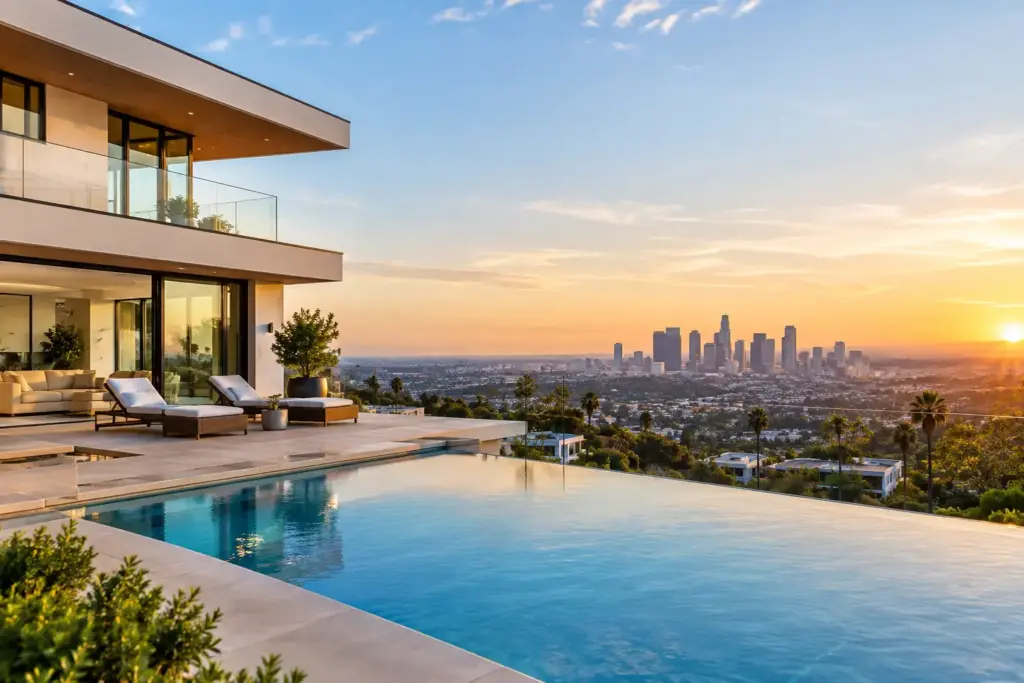


A view property in Bel Air, a walk-street home in Venice, or a gated Malibu retreat can feel like a different category of real estate altogether. But are luxury homes good investments? For the right buyer, in the right Los Angeles location, they can be an exceptional long-term store of value. They are not automatically profitable simply because the finishes are beautiful or the address is prestigious.
Luxury real estate should be evaluated as both a lifestyle asset and an investment. The buyer who understands that distinction is better positioned to protect capital, make a confident offer, and recognize value that may not be obvious in a listing photo or price-per-square-foot comparison.
Are Luxury Homes Good Investments? The Short Answer
Luxury homes can be good investments when they combine enduring location, genuine scarcity, broad future appeal, and a holding period long enough to absorb market cycles and transaction costs. In Los Angeles, a well-bought property in Beverly Hills, Brentwood, Santa Monica, Malibu, Bel Air, or a similarly supply-constrained neighborhood often benefits from demand drivers that are difficult to replicate: climate, privacy, proximity to employment and culture, respected schools, and a globally recognized lifestyle.
However, the luxury market is not one market. A $4 million home in a highly walkable, established neighborhood has different demand dynamics than a $20 million new construction estate on a challenging hillside. A beachfront residence may command remarkable scarcity value, while also carrying coastal maintenance, insurance, and regulatory considerations. The details matter.
For many clients, the strongest outcome comes from purchasing a home they would be genuinely happy to own and live in, while ensuring the asset has the qualities sophisticated buyers will continue to value years from now.
What Creates Investment Value in a Luxury Property?
A luxury price tag does not create investment value. Scarcity does. So does desirability that lasts beyond a particular design trend or market moment.
In Los Angeles, the most resilient properties tend to offer a combination of location and utility. That may mean a flat lot in Beverly Hills, ocean proximity in Santa Monica, an architectural home with privacy in the Hollywood Hills, or a Malibu property with meaningful beach access and strong views. A home that is difficult to replace generally has more pricing support than one of many similar properties competing for the same buyer.
The land itself deserves close attention. In premium neighborhoods, the lot can represent a substantial portion of the property’s value. Lot size, topography, view corridors, street position, usable outdoor space, access, and the ability to expand or remodel can all affect long-term upside. Two homes with comparable interiors may trade very differently because one sits on a superior parcel.
Buyer depth also matters. The best luxury investments appeal to more than one narrow buyer profile. A home with a sensible floor plan, strong entertaining spaces, privacy, parking, and access to daily conveniences can attract families, executives, entrepreneurs, and relocating buyers. A highly personalized home may be spectacular, but its resale audience can be smaller.
Location Still Outweighs Almost Everything Else
Luxury buyers often want a distinctive residence, but they are equally selective about the experience around it. Commute patterns, neighborhood character, restaurants, beach access, schools, security, and the ability to move through Los Angeles efficiently influence demand.
This is why micro-location is so important. On the Westside, being north or south of a major boulevard, near a preferred school district, or on a quiet street rather than a cut-through street can materially affect value. In Malibu, the difference between oceanfront, ocean view, and inland can be substantial. In Beverly Hills and Bel Air, privacy, lot orientation, and ease of access are often as consequential as square footage.
A local advisor should be able to explain not only what has sold, but why one block, view, or lot configuration commands a premium over another.
The Costs That Can Change the Return
Luxury homes carry expenses that should be underwritten before an offer is written, not discovered after closing. Property taxes, insurance, maintenance, landscaping, pool service, security systems, staffing, homeowners association dues, and utilities can be significant. For a property with a guest house, extensive grounds, or aging systems, annual operating costs can change the investment picture quickly.
California insurance deserves particular attention, especially for properties in fire-prone areas or near the coast. Coverage availability, premiums, deductibles, and carrier requirements should be reviewed early. Buyers should also investigate drainage, hillside conditions, retaining walls, septic systems where applicable, sea-level and coastal factors, and prior claims history.
Transaction costs matter as well. Luxury properties are less liquid than lower-priced homes, and selling costs can be meaningful. A short holding period leaves less time for appreciation to offset those costs. In most cases, buyers should approach a luxury residence with a multi-year horizon rather than an expectation of a quick resale.
Financing, Cash, and Opportunity Cost
Many luxury purchases are all-cash, but that does not mean financing is irrelevant. A carefully structured loan can preserve liquidity for a business, market investments, renovations, or additional real estate opportunities. The right approach depends on a buyer’s broader balance sheet, tax planning, risk tolerance, and intended use of the property.
Cash buyers may have an advantage in competitive negotiations, particularly when a seller values certainty and a clean closing. Yet paying cash still has an opportunity cost. Capital committed to a residence is capital that cannot be deployed elsewhere. A thoughtful investment analysis compares the expected benefits of ownership with the buyer’s alternatives, rather than assuming that either leverage or cash is always superior.
For investors considering a luxury home as a rental, the analysis becomes even more specific. Long-term rental demand can be strong in select Los Angeles neighborhoods, but gross rent may not produce the yield an investor expects relative to the purchase price. Short-term rental strategies also require careful review of local rules, permits, neighborhood restrictions, and operational demands. Appreciation and income are separate questions, and a property can perform well on one measure without excelling on the other.
When a Luxury Home May Not Be the Right Investment
There are situations where a luxury purchase should be approached cautiously. Buying at the peak of a highly emotional bidding environment, selecting a home with major deferred maintenance, or overpaying for a design trend that may date quickly can limit future flexibility.
Properties with difficult access, unusual layouts, excessive square footage for the neighborhood, or a highly specialized amenity can also require patience at resale. The same is true when a buyer needs to sell within two or three years. The luxury market can move quickly when demand is strong, but it can also be selective when economic conditions shift.
New construction requires its own diligence. The quality of construction, permits, warranties, contractor history, materials, and future service needs should be evaluated carefully. A polished presentation should never replace a thorough inspection process and clear review of disclosures.
A Better Way to Evaluate a Luxury Purchase
Before focusing on projected appreciation, start with a practical question: would this home remain desirable if the market paused? If the answer is yes because of its location, land, design quality, condition, and livability, the investment case is usually stronger.
Then evaluate recent comparable sales with precision. This means looking beyond headline price per square foot to account for lot quality, view, condition, privacy, school district, guest accommodations, and renovation level. Off-market activity can also be relevant in Los Angeles luxury markets, where some of the most compelling opportunities and transactions are not fully visible through public listing data.
Finally, define the holding strategy before purchasing. Will the home be a primary residence, a part-time residence, a long-term rental, a redevelopment opportunity, or part of a larger portfolio? Each purpose changes the appropriate price, financing structure, tax conversation, and exit plan.
A well-advised buyer does not need to predict every market movement. The goal is to acquire a property with enduring fundamentals at a price supported by real market evidence, while retaining enough flexibility to enjoy the home and hold through normal cycles.
The most rewarding luxury purchases are rarely the ones driven by urgency alone. They are the homes that fit a client’s life now, reflect the irreplaceable qualities of Los Angeles, and remain compelling when the next discerning buyer begins their own search.